I’m obsessively interested in how to create knowledge.
I love to learn about learning. And I love to know about knowledge.
Of course, not everyone will find this interesting, but not all knowledge is created equally. Understanding how knowledge is created makes it easier to understand the strengths and weaknesses of different types of reasoning.
At least, I think so.
Here we go:
How To Create Knowledge
This list of how to create knowledge presents aspects of reasoning, methodological approaches, data analysis perspectives, and philosophical frameworks. It explains how knowledge can be approached, analysed, and interpreted.
Albert Einstein
“If you can’t explain it simply, you don’t understand it well enough.”
Types of Reasoning and Logical Processes
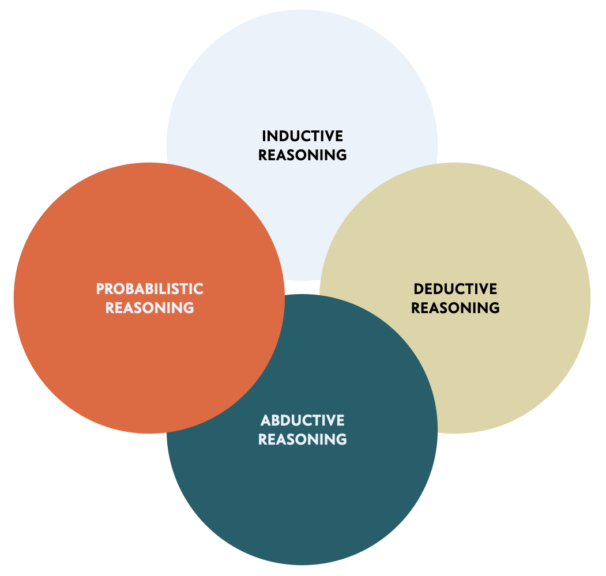
Inductive reasoning. Generalising from specific observations to broader generalizations.
Deductive reasoning. Starting with a general statement or hypothesis and reaching a specific conclusion.
Abductive reasoning. Starting with an observation and seeking the simplest and most likely explanation.
Probabilistic reasoning. Making predictions based on probabilities in uncertain situations.
How to create knowledge.
Methodological Approaches
Empirical vs logical. Empirical—Deriving knowledge from observation or experimentation. Logical—Using structured reasoning and valid arguments independent of empirical evidence.
Heuristic vs algorithmic. Heuristic—Applying practical methods or “rules of thumb” for immediate solutions. Algorithmic—Using systematic procedures for definitive, often optimal solutions.
Data and Analysis Perspectives
Analytical vs synthetic. Analytical—Breaking down complex problems into smaller components. Synthetic—Combining elements to form a coherent whole.
Qualitative vs quantitative. Qualitative—Focusing on non-statistical aspects and qualities. Quantitative—Involving numerical data collection and analysis.
Philosophical and Theoretical Frameworks
Rationalism vs empiricism. Rationalism—Emphasising reason as the primary source of knowledge. Empiricism—Stressing the importance of sensory experience and evidence.
Positivism. Asserting that scientific knowledge is the true form of knowledge.
Hermeneutics. Focusing on the interpretation of texts, language, and symbols.
Phenomenology. Concentrating on the study of consciousness and direct experience.
Pragmatism. Considering practical consequences as vital in meaning and truth.
Constructivism. Suggesting that knowledge is constructed from experiences and ideas.
Deconstruction. Analysing philosophical and literary language to uncover implicit assumptions.
We easily fall prey to the tricks our psychology plays on us. These “thinking errors” exist because they’ve often aided our survival. However, knowing and understanding various types of common fallacies and biases is helpful in everyday life.
Here are a few examples of logical fallacies and biases that I’ve come across while studying public relations and linguistics:
Fallacy of Composition
Fallacy of Division
The Gambler’s Fallacy
Tu Quoque (Who Are You To Talk?)
Strawman
Ad Hominem
Genetic Fallacy (Fallacy of Origin or Fallacy of Virtue)
Cook, J. & Lewandowsky, S. (2011). The debunking handbook. St. Lucia, Australia: University of Queensland.
Dwyer, C.P. (2017). Critical thinking: Conceptual perspectives and practical guidelines. Cambridge, UK: Cambridge University Press; with a foreword by former APA President, Dr Diane F. Halpern.
Dwyer, C. P., Hogan, M. J., & Stewart, I. (2014). An integrated critical thinking framework for the 21st century. Thinking Skills & Creativity, 12, 43 – 52.
Forer, B. R. (1949). The Fallacy of Personal Validation: A classroom Demonstration of Gullibility. Journal of Abnormal Psychology, 44, 118 – 121.
Kahneman, D. (2011). Thinking fast and slow. Penguin: Great Britain.
Simon, H. A. (1957). Models of man. New York: Wiley.
Thaler, R. H. (1999). Mental accounting matters. Journal of Behavioral Decision Making, 12, 183 – 206.
Tversky, A. & Kahneman, D. (1974). Judgment under uncertainty: Heuristics and biases. Science, 185, 4157, 1124 – 1131.
West, R. F., Toplak, M. E., & Stanovich, K. E. (2008). Heuristics and biases as measures of critical thinking: Associations with cognitive ability and thinking dispositions. Journal of Educational Psychology, 100, 4, 930 – 941.
Thanks for reading. Need a PR specialist? Please contact Jerry for a consultation.
Spin Academy | Online PR Courses
Renaissance projects.
Improvement: Renaissance Projects
The Renaissance lasted from the 14th to the 17th century and was a period of significant cultural, artistic, political, and scientific rebirth in Europe.
Inspired by the Renaissance mindset, I strive to develop my creative intelligence, physical strengths, and mental well-being.
Jerry Silfwer, alias Doctor Spin, is an awarded senior adviser specialising in public relations and digital strategy. Currently CEO at Spin Factory and KIX Communication Index. Before that, he worked at Whispr Group NYC, Springtime PR, and Spotlight PR. Based in Stockholm, Sweden.
The Cover Photo
The cover photo isn't related to public relations obviously; it's just a photo of mine. Think of it as a 'decorative diversion', a subtle reminder that it's good to have hobbies outside work.
The cover photo has
.
Subscribe to SpinCTRL—it’s 100% free!
Join 2,550+ fellow PR lovers and subscribe to Jerry’s free newsletter on communication and psychology.
What will you get?
> PR commentary on current events.
> Subscriber-only VIP content.
> My personal PR slides for .key and .ppt.
> Discounts on upcoming PR courses.
> Ebook on getting better PR ideas.
Subscribe to SpinCTRL today by clicking SUBSCRIBE and get your first free send-out instantly.