

I often suggest the deep content PR strategy.
Deep content isn’t complicated — and the results are predictable.
The downside: You have to put in the work and create helpful content — lots of it. Also, growth is usually a slow burn. Still, slow and steady wins the (SEO) race!
Here we go:
Deep Content
Deep content is focused on providing increasingly higher-quality information to content divers (as opposed to content surfers).
In the example, five layers of evergreen content are stacked vertically on a quarterly timeline:
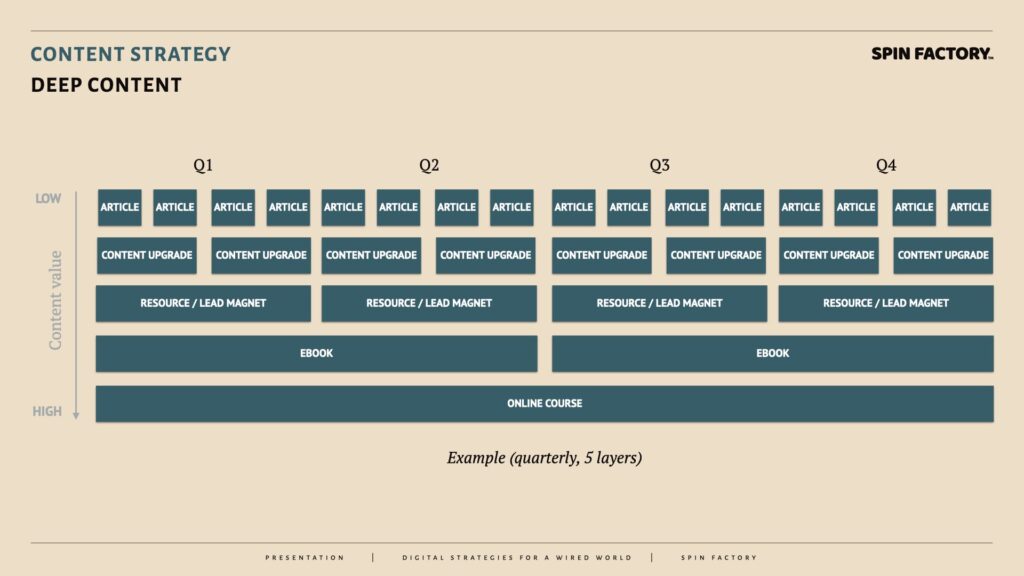
Example of a five-layer deep content structure:
This inbound logic is similar to iceberg publishing and content themes regarding structure and depth.
Learn more: The Deep Content PR Strategy
Content Surfers and Content Divers
If a user has shown interest in your surface-level content and wants to explore and learn more, your brand must have something to offer at those deeper levels.
When users are satisfied, they decide when not to go any deeper. Your commitment to this strategy is to ensure that users never leave because the option to go deeper doesn’t exist.
As a rule of thumb:
A user’s website journey should never end due to the brand’s failure to provide relevant information.
Since all relevant information can’t be easily presented simultaneously, organisations must provide online information several layers deep. They must provide deep content.
Why is website depth so important?
Content surfers (moving horizontally) look around, turning over stones here and there. Content divers (moving vertically), on the other hand, immerse themselves — which is extremely valuable from a brand’s perspective.
The minority who click your content’s call to action (content diver = moving vertically) is exponentially more valuable than the majority who scan and move along (content surfer = moving horizontally).
Content divers have a more narrow and focused intent. According to most website metrics, they don’t mind scrolling vertically and clicking — as long as the content becomes increasingly more relevant to their needs.
Placing your brand’s most valuable and in-depth content at the “bottom” might seem counter-intuitive:
Content divers will quickly abandon ship if they notice that your content is getting worse and worse the deeper they go.
Learn more: Content Surfers and Content Divers
The Press Release Paradox
Think of a regular press release:
How do most press releases end?
“For more information, please contact:”
That’s not a clear, precise, or enticing call to action.
Most press release writers try to make the headline more compelling than the actual press release. Then, they make the first two sentences more interesting than the rest of the text.
The longer you read, the less attractive the content becomes. So, the deeper into the press release you go, the less you’re being “rewarded” for donating your valuable attention.
If someone is interested enough in your press release to read it to the end, shouldn’t they be treated with a little more respect?
Huh.
Press releases are designed to become duller the further down the page you read. The same can be said for how traditional news articles are structured. But this old-school approach isn’t a good fit for a digital-first world.
Learn more: The Press Release Paradox (to be published)
Strategic Prerequisites and Fit
The deep content PR strategy isn’t necessarily the right fit for all brands:
Deep content is SEO-friendly and caters to online audiences looking to dive deeper into specific niches. It’s a good fit for business-to-business ventures. It’s a good fit for thought leadership PR strategies.
However, the deep content PR strategy also goes beyond conventional white-collar industries:
Users are also looking to go deep in the most creative of spaces. It can be anything from music to art, from gaming to collectables. Many online publics are interested in diving into the most remote online deepsea trenches imaginable.
Thanks for reading. Need a PR specialist?
Please contact Jerry for a consultation.
What should you study next?
Spin Academy | Online PR Courses

Spin’s PR School: Free Strategy PR Course
Unlock the power of strategic public relations with this free Strategy PR Course. Elevate your skills and boost your career today.
Public Relations Strategy 101
Public Relations Strategies
Grey-Hat PR Strategies
Learn more: All Free PR Courses
💡 Subscribe and get a free ebook on how to get better PR.

What should you study next?
Spin Academy | Online PR Courses

Spin’s PR School: Free Content PR Course
Unlock your potential with this Free Content PR Course. Learn effective digital public relations strategies and elevate your career to new heights today.
Content Communications
Content Management
Content Strategies
Learn more: All Free PR Courses
💡 Subscribe and get a free ebook on how to get better PR.