

The inbound shift PR strategy requires a new mindset.
As optimising web content becomes increasingly essential, the inbound shift is becoming an intriguing opportunity for public relations.
But when it comes to inbound communications, most PR professionals today think about landing pages and conversion rates.
However — inbound communications is also a PR strategy.
Here we go:
The Inbound Shift
As public relations professionals, we must rethink how we think about publics. Traditionally, many PR departments have argued:
“Why should we waste budgets on ‘already acquired’ audiences?”
The truth is — it’s the other way around.
The inbound shift is a fundamental mindset change in the public relations industry.

Instead of “spamming” non-existing audiences, public relations and marketing can do much more with existing online publics. 1Silfwer, J. (2015, June 11). The Publics in Public Relations. Doctor Spin | The PR Blog. https://doctorspin.net/publics-in-public-relations/
Inbound vs Outbound: The Difference
Inbound vs outbound is the online equivalent of drawing the line between those who know you and those who don’t.
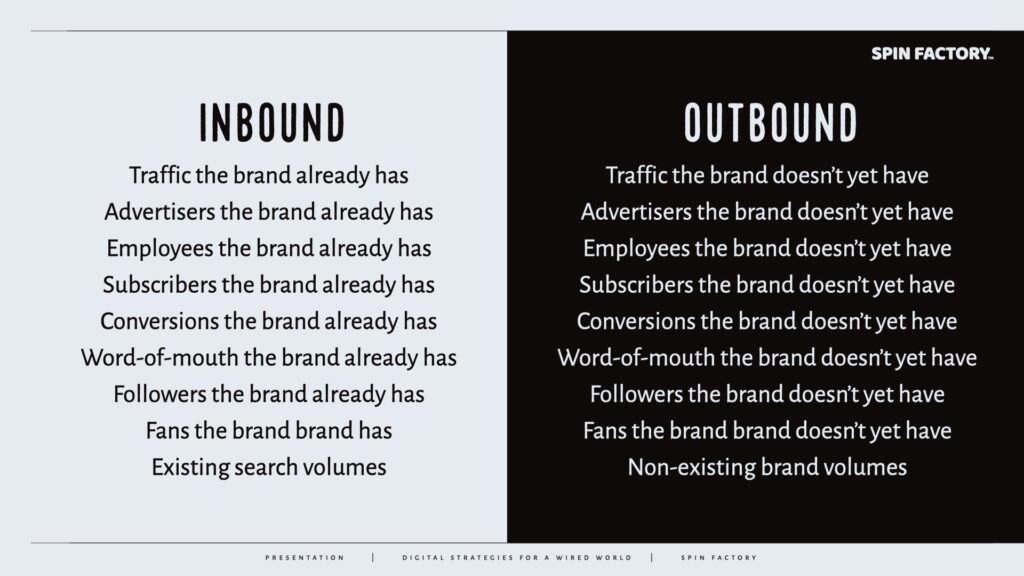
Drawing a line between those who know you and those who don’t know you is nothing new:
If your inbound shift PR strategy is strong, you might no longer need to prioritise your outbound PR strategies since your inbound audience will attract outbound publics!
Learn more: The Inbound Shift PR Strategy
Iceberg Publishing
You could think of your website as an iceberg.
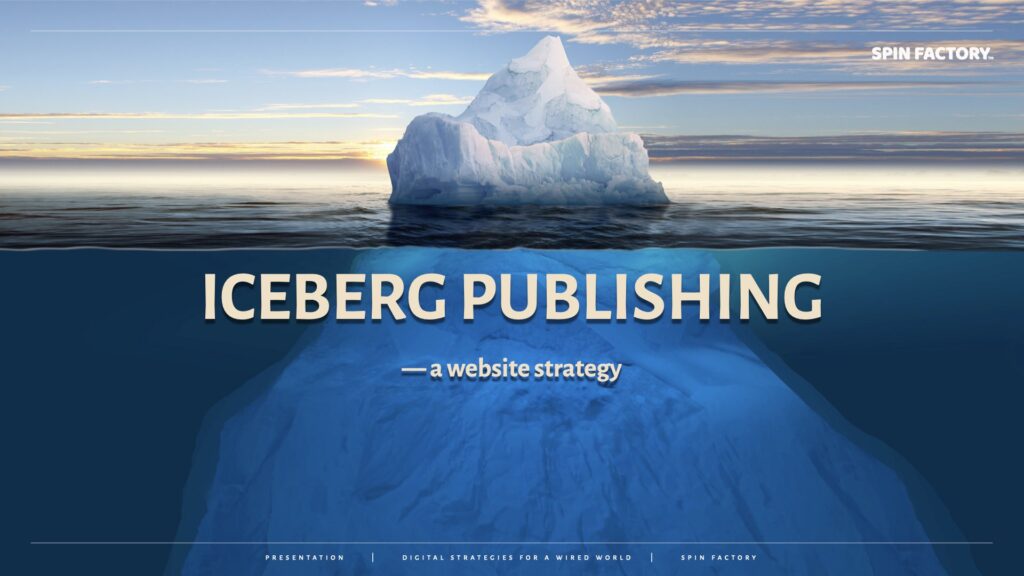
A characteristic of an iceberg is that whatever you see of the iceberg floating above the surface, you can be sure that the iceberg is many times larger underneath the surface.
“Typically about one-tenth of the volume of an iceberg is above water, which follows from Archimedes’s Principle of buoyancy; the density of pure ice is about 920 kg/m3 (57 lb/cu ft), and that of seawater about 1,025 kg/m3 (64 lb/cu ft). The contour of the underwater portion can be difficult to judge by looking at the portion above the surface.”
Source: Wikipedia
So, “above the surface” is where some of your pages are easily accessible from your site navigation (menu links, footer links, sidebar links, etc.). And then, “beneath the surface”, you place a vast array of web pages not directly linked to your navigation — landing pages.
Iceberg publishing has five key components:
The way to think about iceberg publishing is to imagine building a website where intent-driven and highly converting landing pages vastly outnumber basic and conventional web pages.
Learn more: Iceberg Publishing
What is a Landing Page?
What is a landing page?
Landing page (LP) = a single-purpose web page stripped of standard menus and sidebars with a single CTA (call-to-action) chosen to match the visitor’s demonstrated intent.
Why do landing pages work well?
A landing page is typically a web page with one singular call-to-action — or the same call-to-action repeated vertically. To maximise conversions, these pages are often stripped of sidebars, navigational menus, footers, etc.
For intent-driven and clear call-to-action inspiration, please study how Google uses their front page as a clean, high-converting landing page.

Learn more: What is a Landing Page?
Types of Landing Pages
Here are a few examples of different landing page types:
Each landing page type serves a specific purpose in the customer journey, focusing on a single objective: increasing conversions by harvesting demonstrated user intent.
Only your imagination will determine what types of efficient landing pages you can develop!
Read also: Types of Landing Pages
Inbound Communications is Good PR
Inbound communications is more than deploying various tactics to capture online leads.
If your site isn’t growing, what happens if you compensate for that lack of engagement by paying to 10x your traffic? Now you have 10x the number of people who are not engaged — and your budget is spent. Doesn’t make much sense, right?
Many brands focus on landing pages for list building, content themes, call-to-actions, viral loops, conversion rates, lead magnets, content upgrades, landing pages, a/b‑testing, marketing automation, email marketing, etc.
Most companies want more traffic, fans, emails, and sales. But in most cases, reaching new outbound audiences isn’t the real problem:
If you successfully engage your existing yet small online audience, it won’t stay small for much longer. In a wired world, people influence each other, and people influence social media algorithms.
And that’s the raw PR power of inbound communications.
Thanks for reading. Need a PR specialist?
Please contact Jerry for a consultation.
What should you study next?
Spin Academy | Online PR Courses

Spin’s PR School: Free Strategy PR Course
Unlock the power of strategic public relations with this free Strategy PR Course. Elevate your skills and boost your career today.
Public Relations Strategy 101
Public Relations Strategies
Grey-Hat PR Strategies
Learn more: All Free PR Courses
💡 Subscribe and get a free ebook on how to get better PR.

Annotations
| 1 | Silfwer, J. (2015, June 11). The Publics in Public Relations. Doctor Spin | The PR Blog. https://doctorspin.net/publics-in-public-relations/ |
|---|---|
| 2 | Silfwer, J. (2015, October 4). Beware of Conversion Cannibalism. Doctor Spin | The PR Blog. https://doctorspin.net/conversion-cannibalism/ |