

Try this simple ikigai test.
I am (like many others, I’m sure) partial to the concept of ikigai (生き甲斐). Ikigai is a Japanese concept that means “reason for being.”
How can you use the ikigai test for self-development?
Here we go:
The Ikigai Test
Have you been pondering your raison d’être? The term ikigai comes from two Japanese words:
While the Western adaptation often treats ikigai like a productivity hack or a purpose-finding workshop, it’s less rigid in its original Japanese context. It doesn’t require you to monetise your passion or save the world — it can simply mean appreciating small joys, like sipping tea on a quiet morning or tending to a bonsai tree.
It’s more about process than outcome.
Ikigai is often described as the intersection of what you love, what you’re good at, what the world needs, and what you can be paid for — a harmonious convergence that supposedly leads to a fulfilling life.
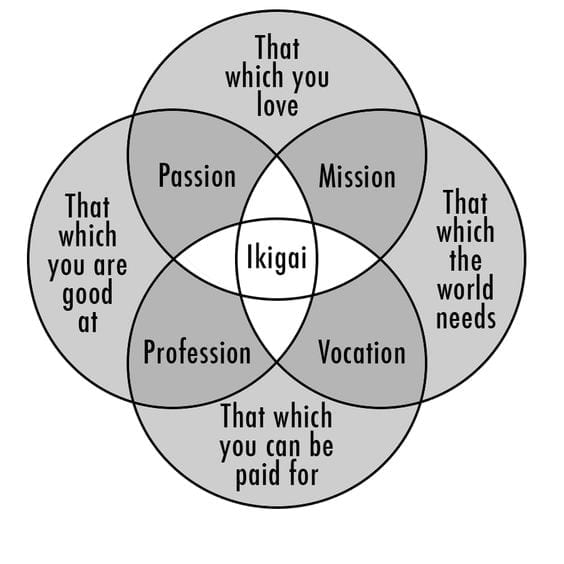
Here’s the first step of the ikigai test for the intersecting middle layer, where I would say that:
Then, here’s the second step of my ikigai test for the outer layer (based on my middle layer answers):
1. That which I love (Passion & Mission): Communication & Teaching
2. That which the world needs (Mission + Vocation): Teaching + Learning and Sharing
3. That which I can get paid for (Profession + Vocation): Public Relations + Learning and Sharing
4. That which I’m good at (Passion + Profession): Communication + Public Relations
All good. My answers seem to work well with the outer layer of the Ikigai diagram.
So, for the third step, and based on my answers, what can I place in the centre (the Ikigai) that works?
Whohoo! That works!
Can you make it work, too?
Nota bene:
I understand that turning ikigai into “find your dream job!” is like using meditation to increase productivity — missing the point entirely.
Life doesn’t have to be perpetually meaningful or joyous. Striving for constant alignment of these circles can sometimes add unnecessary pressure.
Learn more: The Ikigai Test
Concluding Thoughts
While doing this little exercise, I was surprised that teaching came to me without hesitation. There’s a distinct difference between doing things for others (like a consultant) and showing people how to do them for themselves (like a teacher).
Moving forward, I will try to be mindful of this difference to ensure that my ikigai becomes a reality — for myself and everyone around me.

THANKS FOR READING.
Need PR help? Hire me here.

What should you study next?
Spin Academy | Online PR Courses

Improvement: Renaissance Projects
The Renaissance lasted from the 14th to the 17th century and was a period of significant cultural, artistic, political, and scientific rebirth in Europe.
Inspired by the Renaissance mindset, I strive to develop my creative intelligence, physical strengths, and mental well-being.
Better Identity
Better Thinking
Better Skills
Better Habits
Learn more: Creativity
💡 Subscribe and get a free ebook on how to get better PR.