

Evergreen content is the gift that keeps on giving.
Instead of struggling to push out newsworthy information daily, focusing on publishing long-lasting content has many benefits.
Evergreen content might be the worst-kept secret in marketing, but the public relations industry, infatuated by the idea of ‘news,’ often overlooks the concept.
Here we go:
Evergreen Content
What’s evergreen content?
Evergreen content is an inbound approach to building core messages, content themes, content packages, deep content, and content skyscrapers.
For a piece of content to be evergreen, it must sustain its value over time. This means the content must be relevant today, tomorrow, and the foreseeable future.
While news content might make a more significant short-term splash, evergreen content accumulates online impact over time—which requires patience.
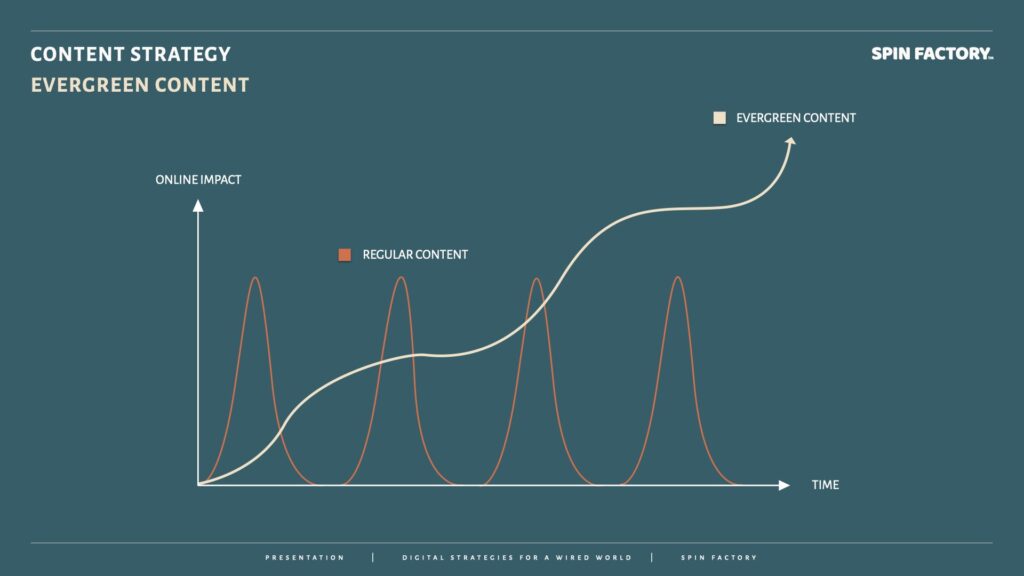
Now, forever is a long time. I typically apply these arbitrary rules to determine what constitutes evergreen content:
Learn more: The Evergreen Content PR Strategy
Evergreen Content + Deep Content = Boom
I might be knocking down open doors here, but:
Search engines generally have no problem with “old content” — as long as the content performs well, Google will likely see the content as good. And if your evergreen content is excellent, it’ll have more time to attract links from other platforms.
However, the most obvious benefit is that the evergreen approach will allow you to build deep content over time:
Deep Content
Deep content is focused on providing increasingly higher-quality information to content divers (as opposed to content surfers).
In the example, five layers of evergreen content are stacked vertically on a quarterly timeline:
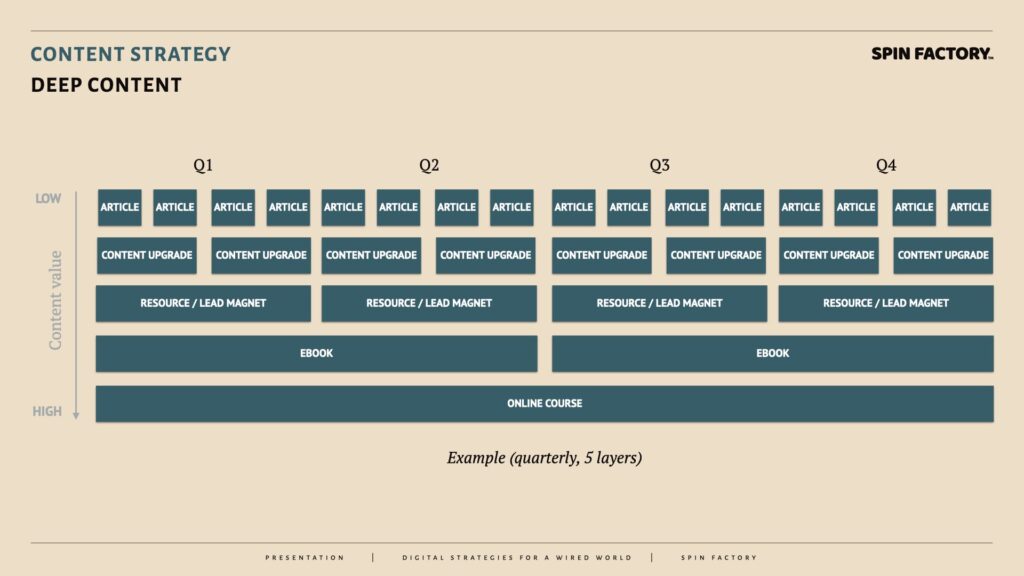
Example of a five-layer deep content structure:
This inbound logic is similar to iceberg publishing and content themes regarding structure and depth.
Learn more: The Deep Content PR Strategy
The Inbound Shift
As public relations professionals, we must rethink how we think about publics. Traditionally, many PR departments have argued:
“Why should we waste budgets on ‘already acquired’ audiences?”
The truth is — it’s the other way around.
The inbound shift is a fundamental mindset change in the public relations industry.

Instead of “spamming” non-existing audiences, public relations and marketing can do much more with existing online publics. 1Silfwer, J. (2015, June 11). The Publics in Public Relations. Doctor Spin | The PR Blog. https://doctorspin.net/publics-in-public-relations/
Inbound vs Outbound: The Difference
Inbound vs outbound is the online equivalent of drawing the line between those who know you and those who don’t.
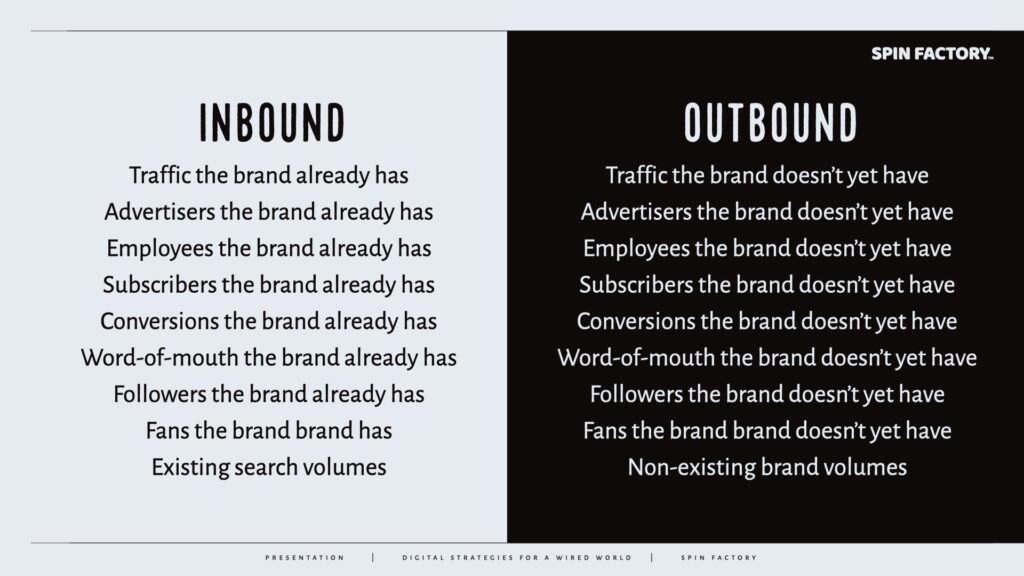
Drawing a line between those who know you and those who don’t know you is nothing new:
If your inbound shift PR strategy is strong, you might no longer need to prioritise your outbound PR strategies since your inbound audience will attract outbound publics!
Learn more: The Inbound Shift PR Strategy
PR + Evergreen = Struggle
So, why is the PR industry struggling with a basic concept like evergreen content?
The answer is simple:
Traditional PR professionals are hardwired for news.
New = Great for PR
Old = Unusable for PR
Our fixation on newsworthiness is helpful in traditional media relations but a handicap in digital PR.
There are oceans of knowledge readily available for publishing within many organisations, but no one is contemplating making all of this valuable information available on the internet. Why?
When I bring it up, I’m told, “Who cares about this stuff? It’s old!”
I used to counter with, “It might seem old to you, but it’s not old to everyone.” But it has been a weak argument befalling deaf ears.
The Online Wisdom Argument
So, how do you promote evergreen content to a seasoned PR professional who sees the world through the lens of newsworthiness?
I find that it works to talk about search engines:
First, I ask them if they use search engines. When they say yes, I ask them how often. When they say often, I ask them how often they search for news. When they say not often, I ask them what they search for — if it isn’t news.
Turns out also seasoned PR professionals use search engines primarily to find evergreen content.
Then I ask them if they want people seeking evergreen knowledge only to find competitors. They don’t.
Then I say, “What if making tried-and-true wisdom available online could be a powerful strategy?” This sort of argument hits home every time with senior professionals. No surprise, right?
Thanks for reading. Need a PR specialist?
Please contact Jerry for a consultation.
What should you study next?
Spin Academy | Online PR Courses

Spin’s PR School: Free Strategy PR Course
Unlock the power of strategic public relations with this free Strategy PR Course. Elevate your skills and boost your career today.
Public Relations Strategy 101
Public Relations Strategies
Grey-Hat PR Strategies
Learn more: All Free PR Courses
💡 Subscribe and get a free ebook on how to get better PR.

Annotations
| 1 | Silfwer, J. (2015, June 11). The Publics in Public Relations. Doctor Spin | The PR Blog. https://doctorspin.net/publics-in-public-relations/ |
|---|