

Woke journalism is bad news.
No one could have missed the ongoing culture war.
In the spirit of cancel culture, anyone who disagrees should be silenced by semi-organised online slacktivists.
But what happens if we allow extremes to dominate the news agenda? To consider woke journalism to be bad news might be a gross underestimation.
Here we go:
When News Narratives Become Online Activism
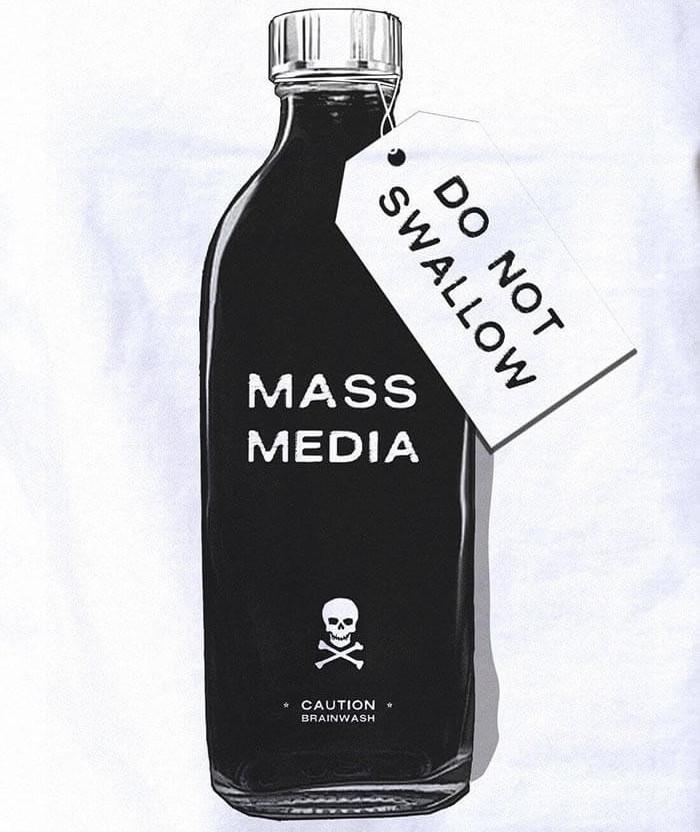
The current landscape of journalism, often labelled as ‘woke’ by its detractors, presents a complex media ecosystem.
The pervasive culture war, a term that has become a mainstay in contemporary discourse, is an omnipresent narrative impossible to overlook.
There exists a notion, perhaps in line with the ideals of what is popularly known as ‘cancel culture,’ positing that those who diverge from virtue signaling find themselves at risk of being ostracised by a vocal cadre of online activists.
However, one must ponder the implications of allowing such online activism to steer the direction of our news narrative. Describing the potential outcome as merely ‘bad news’ might be a gross understatement, hinting at a more profound, nuanced dilemma.
Left-Leaning Journalism? Fine By Me!
In journalism, the predisposition towards left-leaning perspectives emerges more as a statistical tendency than a steadfast principle.
Contrary to the stance often adopted by many in public relations, I harbour no qualms about this leftward inclination among journalists.
There’s a certain comfort in knowing that journalists tirelessly endeavour to bring to light the actions of various elites.
While possessing power and influence doesn’t inherently corrupt, it undeniably magnifies the repercussions of detrimental actions. Given the constraints on journalistic resources, it’s pragmatic to focus where the impact is most significant.
It’s not necessarily that the left excels in narrative craft; statistically, their stories often hold more weight.
For me, the prevalence of journalists with a left-leaning bias is a circumstance I find quite acceptable.
Political Correctness in Journalism
But there are also extremist varieties. From a news media perspective, one particularly hazardous persuasion is where journalism abandons stories about individuals on behalf of sweeping generalisations based on demographic affinity.
I’m talking about woke journalism:
“With an increase in social consciousness and a rise in the millennial culture of being ‘woke’, there has come an increase demand of political correctness especially in journalism. On one hand lies the decency of a report that gives journalists an authority to phrase their stories in an ethical way using political correctness. On the other hand, it does hinder honesty or true freedom of speech.”
Source: Political correctness: An obstacle for media?
When we filter news stories through ethnicity, group beliefs, sexual orientation, and ancient injustices, we get journalists promoting a mandatory disregard of objectivity on behalf of subjective interests.
Read also: How To Fight Populism
This blatant disregard for the truth unites the alt-leftist woke movement with their ideological counterparts — the fascists and the populists.
Should journalism take sides here?
Woke Journalism in the Post-Triage Era
Imagine being a medic arriving at the scene of a massive accident with lots of wounded people all around you.
Triage, the practice of medical priority, means that you won’t tend to those screaming the loudest first; they have enough energy and life spark to shout and make noise.
If saving lives is the medic’s priority, they should prioritise those who can’t even make noise to protect themselves.
If the medic, however well-intentioned or righteous, takes it upon themself to save people based on group identity, the whole medical system will quickly start to break down from within.
“We’ve been here before — on college campuses in the late 1960s, when student protesters occupied buildings, making demands for curricular and other changes, and administrators and prominent faculty members gave in across the board. The students at Columbia and Cornell were leading a revolution from the left, and the authorities who surrendered to them were liberals. The liberals folded because they were terrified of bad publicity, but also because they felt shamed by the moral purity, clarity, passion, and certainty of the young rebels. In all those respects, our newsroom revolutions are following the same script.”
Source: The woke revolution in American journalism has begun
Team Woke vs Team Resentful
“On social media, the country seems to divide into two neat camps: Call them the woke and the resentful. Team Resentment is manned — pun very much intended — by people who are predominantly old and almost exclusively white. Team Woke is young, likely to be female, and predominantly black, brown, or Asian (though white “allies” do their dutiful part). These teams are roughly equal in number, and they disagree most vehemently, as well as most routinely about the catchall known as political correctness. Reality is nothing like this. As scholars Stephen Hawkins, Daniel Yudkin, Miriam Juan-Torres, and Tim Dixon argue in a report published Wednesday, “Hidden Tribes: A Study of America’s Polarised Landscape,” most Americans don’t fit into either of these camps.”
Source: Americans Strongly Dislike PC Culture
Where have all balanced voices gone if most people don’t fit into these loud, self-proclaimed, self-righteous coalitions?
Where are all those people who don’t have a public voice?
Platform Amplifiers Instead of Platform Providers
Suppose we allow the news media to become platform amplifiers instead of platform providers. In doing so, we pave the way for censorship, cancel culture, propaganda, and damaging identity politics on both the far left and the far right of the political spectrum.
It’s not a journalist’s job to protect and promote those who already have a voice and a platform. But woke journalism will empower already strong voices over uncomfortable ones.
How does this work?
There are three psychological explanation models worth considering:
Model 1: The Spiral of Silence
The Spiral of Silence Theory
Elisabeth Noelle-Neumann’s (1916 – 2010) well-documented theory on the spiral of silence (1974) explains why the fear of isolation due to peer exclusion will pressure publics to silence their opinions.

The theory was developed in the late 1970s in West Germany, partly in response to Noelle-Neumann’s observations of how public opinion seemed to shift during the Nazi régime and post-war Germany.
The spiral of silence theory is based on the idea that people fear social isolation. This fear influences their willingness to express their opinions, especially if they believe these opinions are in the minority.
Rather than risking social isolation, many choose silence over expressing their opinions.
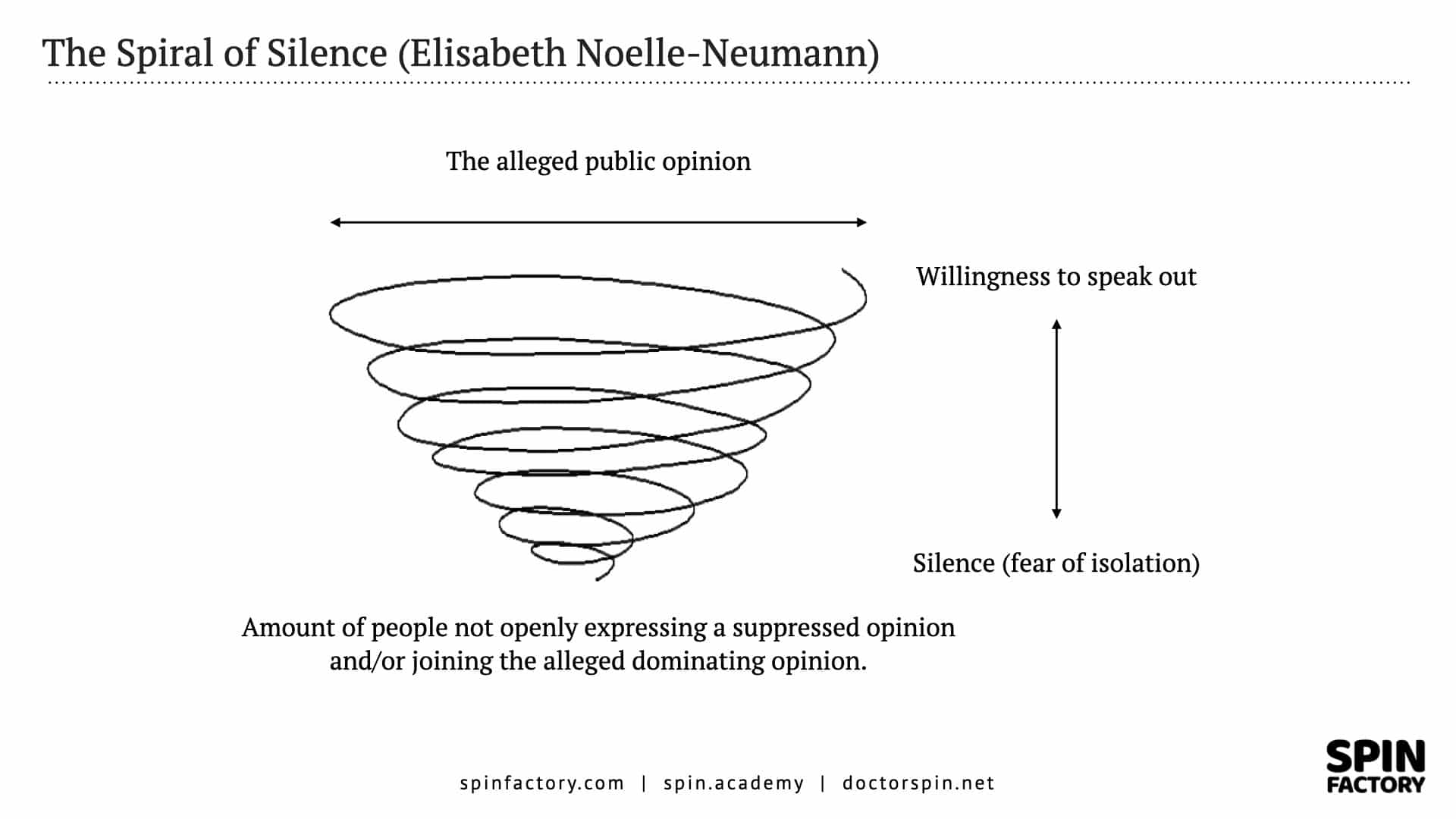
As the dominant coalition stands unopposed, they push the confines of what’s acceptable down a narrower and narrower funnel, the so-called opinion corridor). 1Opinion corridor. (2023, April 8). In Wikipedia. https://en.wikipedia.org/wiki/Opinion_corridor
Noelle-Neumann emphasised the media’s role in shaping public perception of what opinions are dominant or popular, thus influencing the spiral of silence.
Populism and Cancel Culture
The mechanisms behind Elisabeth Noelle Neumann’s spiral of silence theory could fuel destructive societal phenomena like populism and cancel culture:
In both cases, the spiral of silence contributes to a polarised environment. Views become dominant not necessarily because they are more popular but because opposing views are not expressed due to fear of social isolation or repercussions.
Learn more: The Spiral of Silence
Model 2: The Conversion Theory
The Conversion Theory
The social psychologist Serge Moscovici found that we become more engaged if we belong to a misrepresented minority.
The disproportional power of minorities is known as the conversion theory. 4Conversion theory of minority influence. (2021, February 12). In Wikipedia. https://en.wikipedia.org/wiki/Conversion_theory_of_minority_influence
“In groups, the minority can have a disproportionate effect, converting many ‘majority’ members to their own cause. This is because many majority group members are not strong believers in its cause. They may be simply going along because it seems easier or that there is no real alternative. They may also have become disillusioned with the group purpose, process, or leadership and are seeking a viable alternative.”
Source: Changingminds.org 5Conversion Theory. (2023). Changingminds.org. https://changingminds.org/explanations/theories/conversion_theory.htm
How does it work?
The social cost of holding a different view than the majority is high. This increased cost explains why minorities often hold their opinions more firmly. It takes determination to go against the norm. 6Moscovici, S. (1980). Toward a theory of conversion behaviour. In L. Berkowitz (Ed.), Advances in Experimental Social Psychology, 13, 209 – 239. New York: Academic Press
In contrast, many majority members don’t hold their opinions so firmly. They might belong to the majority for no other reason than that everyone else seems to be. 7Chryssochoou, X. and Volpato, C. (2004). Social Influence and the Power of Minorities: An Analysis of the Communist Manifesto, Social Justice Research, 17, 4, 357 – 388
According to conversion theory, while majorities often claim normative social influence, minorities strive for ethical high ground.
Conversion Theory Examples
Given the power of normative social influence, minorities typically form tight-knit groups that can gather around a core message.
Most big shifts usually start with a small group of dedicated people:
Minority Influence: A PR Approach
Organisations with CSR aspirations can cultivate a sense of purpose and accomplishment among participants by aligning with a movement that challenges a stupid majority.
Since we tend to favour underdogs, liaising with a carefully selected minority can be a game-changing PR strategy.
Minority spokespersons with solid convictions often possess valuable knowledge and authority, enhancing their persuasive abilities and influence.
Disproportionately, minorities can convert numerous majority members to their cause, as many in the majority may have merely followed the path of least resistance, made decisions without much consideration, or lacked viable alternatives.
Additionally, a significant segment of the majority might be disillusioned with their group’s purpose, process, or leadership, rendering them more receptive to alternative proposals.
Proceed With Caution, Please
As PR professionals, we must be cautious when implementing the conversion theory.
Minorities aren’t always right, and majorities aren’t always wrong. Minorities can hold futile views while still exercising a disproportionate amount of power.
Learn more: Conversion Theory: The Disproportionate Influence of Minorities
Model 3: The Amplification Hypothesis
The Amplification Hypothesis
It’s common to find that counterarguments strengthen existing beliefs instead of weakening them.
The harder you attack someone verbally, the more you convince them of their belief, not yours.
The phenomenon is known as the amplification hypothesis, where displaying certainty about an attitude when talking with another person increases and hardens that attitude.
“Across experiments, it is demonstrated that increasing attitude certainty strengthens attitudes (e.g., increases their resistance to persuasion) when attitudes are univalent but weakens attitudes (e.g., decreases their resistance to persuasion) when attitudes are ambivalent. These results are consistent with the amplification hypothesis.“
Source: Journal of Personality and Social Psychology 8Clarkson, J. J., Tormala, Z. L., & Rucker, D. D. (2008). A new look at the consequences of attitude certainty: The amplification hypothesis. Journal of Personality and Social Psychology, … Continue reading
How does the amplification hypothesis work?
In a threatening situation or emergency, we resort to the primal (fastest) part of the brain and survival instincts (fight, flight and freeze). 9Surviving the Storm: Understanding the Nature of Attacks held at Animal Care Expo, 2011 in Orlando, FL.
Establishing common ground and exhibiting empathy demonstrates a genuine understanding of their perspective, fostering trust and openness to your ideas. Conversely, a strategic mismatch of attitudes can serve as a powerful countermeasure if your objective is to deflect persuasive attempts.
Persuade
To persuade, align your attitude with the target. Otherwise, you will only act to create resistance.
Provoke
To put off a persuader, mismatch their attitudes. When they are logical, be emotional, and vice versa.
Learn more: The Amplification Hypothesis: How To Counter Extreme Positions
How To Navigate Cancel Culture
How To Navigate Cancel Culture
“Cancel culture or call-out culture is a phrase contemporary to the late 2010s and early 2020s used to refer to a form of ostracism in which someone is thrust out of social or professional circles — whether it be online, on social media, or in person. Those subject to this ostracism are said to have been ‘cancelled’.”
Source: Wikipedia 13Cancel culture. (2023, January 4). In Wikipedia. https://en.wikipedia.org/wiki/Cancel_culture
The culture war with de-platforming, cancel culture, online lynch mobs, woke journalism, populism, fake news, and moral slacktivism are fast becoming our biggest challenges as PR professionals.
“Cancel culture on social media is a form of public shaming that aims to diffuse public discourse and promote tolerance, but can also be viewed as a form of intolerance against opposing views.”
Source: Rupkatha Journal on Interdisciplinary Studies in Humanities 14Velasco, J. (2020). You are Cancelled: Virtual Collective Consciousness and the Emergence of Cancel Culture as Ideological Purging. Rupkatha Journal on Interdisciplinary Studies in Humanities, 12. … Continue reading
Focus On What Truly Matters
Here’s how to navigate cancel culture as an organisation:
Learn more: Cancel Culture is Evil
The Political Left Should Beware of Woke Journalism, Too
I firmly believe we need journalism of the classical left, where the individual without a voice is given a platform to speak truth to power.
We need objective and brave reporting in the face of severe repercussions from organised, established, and institutionalised elites. We need journalists who care more about the truth than political correctness.
It makes sense for journalism to lean mainly toward the left.
But if that left goes woke, journalism ceases and becomes activism.
“It is undeniable, however, that the propagation of political correctness exerts pressure on journalism and that political correctness in its different facets — information bans, topic bans, and governmental language regulation as well as a trend towards intolerance — poses a threat to independent and self-confident journalism.”
Source: Journalism Research, Edition 1, 2021: Political correctness – a threat to journalism?
Thanks for reading. Need a PR specialist?
Please contact Jerry for a consultation.
Annotations
| 1 | Opinion corridor. (2023, April 8). In Wikipedia. https://en.wikipedia.org/wiki/Opinion_corridor |
|---|---|
| 2 | Silfwer, J. (2018, August 6). How To Fight Populism. Doctor Spin | The PR Blog. https://doctorspin.net/how-to-fight-populism/ |
| 3 | Silfwer, J. (2020, August 24). Cancel Culture is Evil. Doctor Spin | The PR Blog. https://doctorspin.net/cancel-culture/ |
| 4 | Conversion theory of minority influence. (2021, February 12). In Wikipedia. https://en.wikipedia.org/wiki/Conversion_theory_of_minority_influence |
| 5 | Conversion Theory. (2023). Changingminds.org. https://changingminds.org/explanations/theories/conversion_theory.htm |
| 6 | Moscovici, S. (1980). Toward a theory of conversion behaviour. In L. Berkowitz (Ed.), Advances in Experimental Social Psychology, 13, 209 – 239. New York: Academic Press |
| 7 | Chryssochoou, X. and Volpato, C. (2004). Social Influence and the Power of Minorities: An Analysis of the Communist Manifesto, Social Justice Research, 17, 4, 357 – 388 |
| 8 | Clarkson, J. J., Tormala, Z. L., & Rucker, D. D. (2008). A new look at the consequences of attitude certainty: The amplification hypothesis. Journal of Personality and Social Psychology, 95(4), 810 – 825. https://doi.org/10.1037/a0013192 |
| 9 | Surviving the Storm: Understanding the Nature of Attacks held at Animal Care Expo, 2011 in Orlando, FL. |
| 10 | Silfwer, J. (2017, June 13). Conversion Theory — Disproportionate Minority Influence. Doctor Spin | The PR Blog. https://doctorspin.net/conversion-theory/ |
| 11 | Beck (1999): Homogenization, Dehumanization and Demonization. |
| 12 | Cognitive dissonance. (2023, November 20). In Wikipedia. https://en.wikipedia.org/wiki/Cognitive_dissonance |
| 13 | Cancel culture. (2023, January 4). In Wikipedia. https://en.wikipedia.org/wiki/Cancel_culture |
| 14 | Velasco, J. (2020). You are Cancelled: Virtual Collective Consciousness and the Emergence of Cancel Culture as Ideological Purging. Rupkatha Journal on Interdisciplinary Studies in Humanities, 12. https://doi.org/10.21659/rupkatha.v12n5.rioc1s21n2 |