

Subscriber counts matter less and less.
If we know where to look, we can see it clearly:
Earning trust over time gets the algorithmic backseat, while sensational pieces of content get the royal treatment. Why is this happening?
Here we go:
Why Subscriber Counts Matter Less
Like many others interested in photography, I subscribe to Canadian content creator and photographer Peter McKinnon on YouTube. And I’m not alone; 5,55 million subscribers follow McKinnon as I write this.
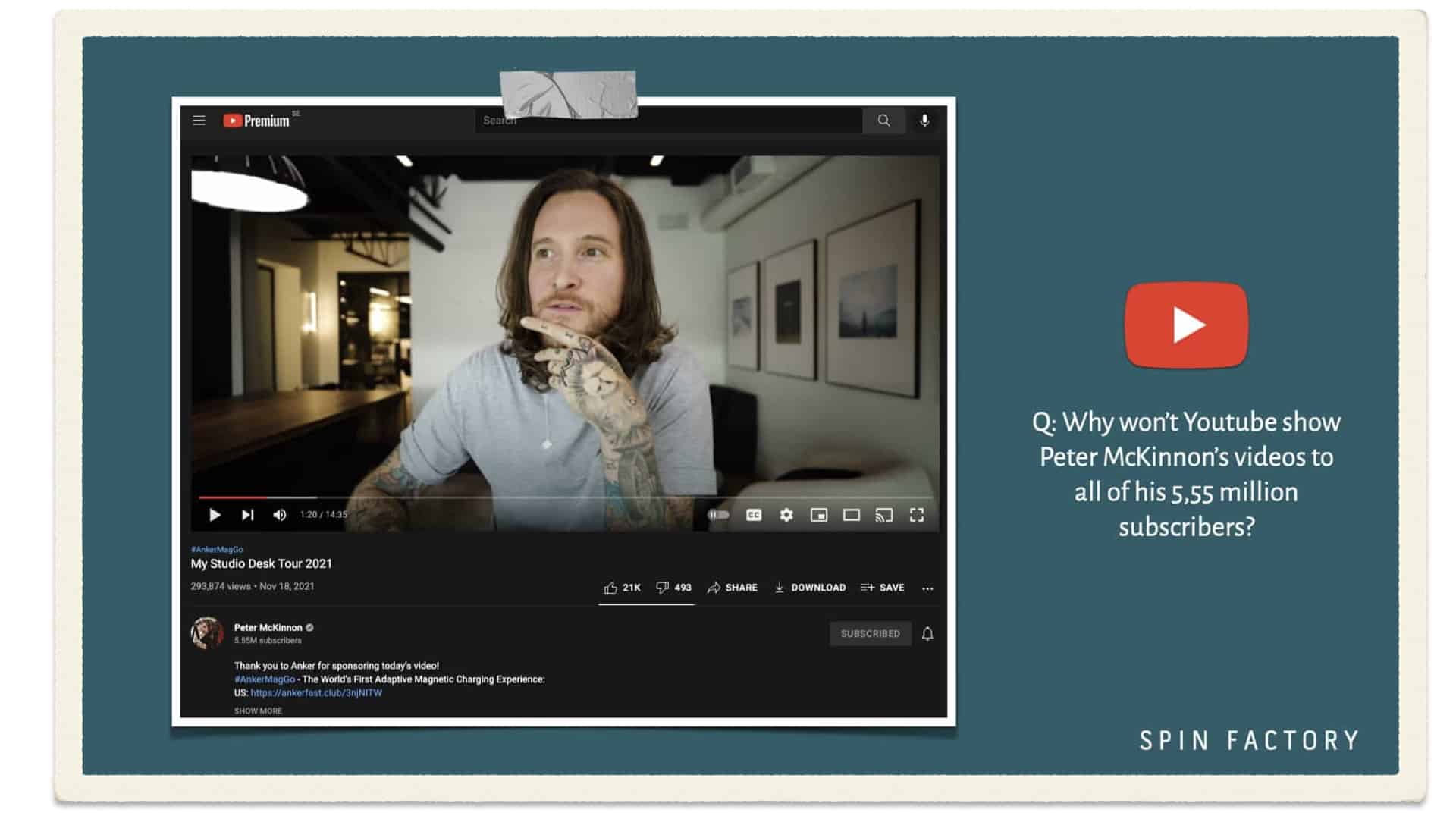
5,55 million is a respectable audience by any measure!
Still, it’s not uncommon for McKinnon’s regular videos to acquire a few hundred thousand views. Don’t get me wrong: I’m not saying a) that a few hundred thousand views are nothing or b) that we should feel sorry for influencers.
I’m saying: A few hundred thousand views is a lot—but it’s not 5,55 million.
Instead of basing algorithmic distribution on McKinnon’s past performance (e.g., subscriber count, total views earned, etc.), YouTube tests each new video using the single content algorithm.
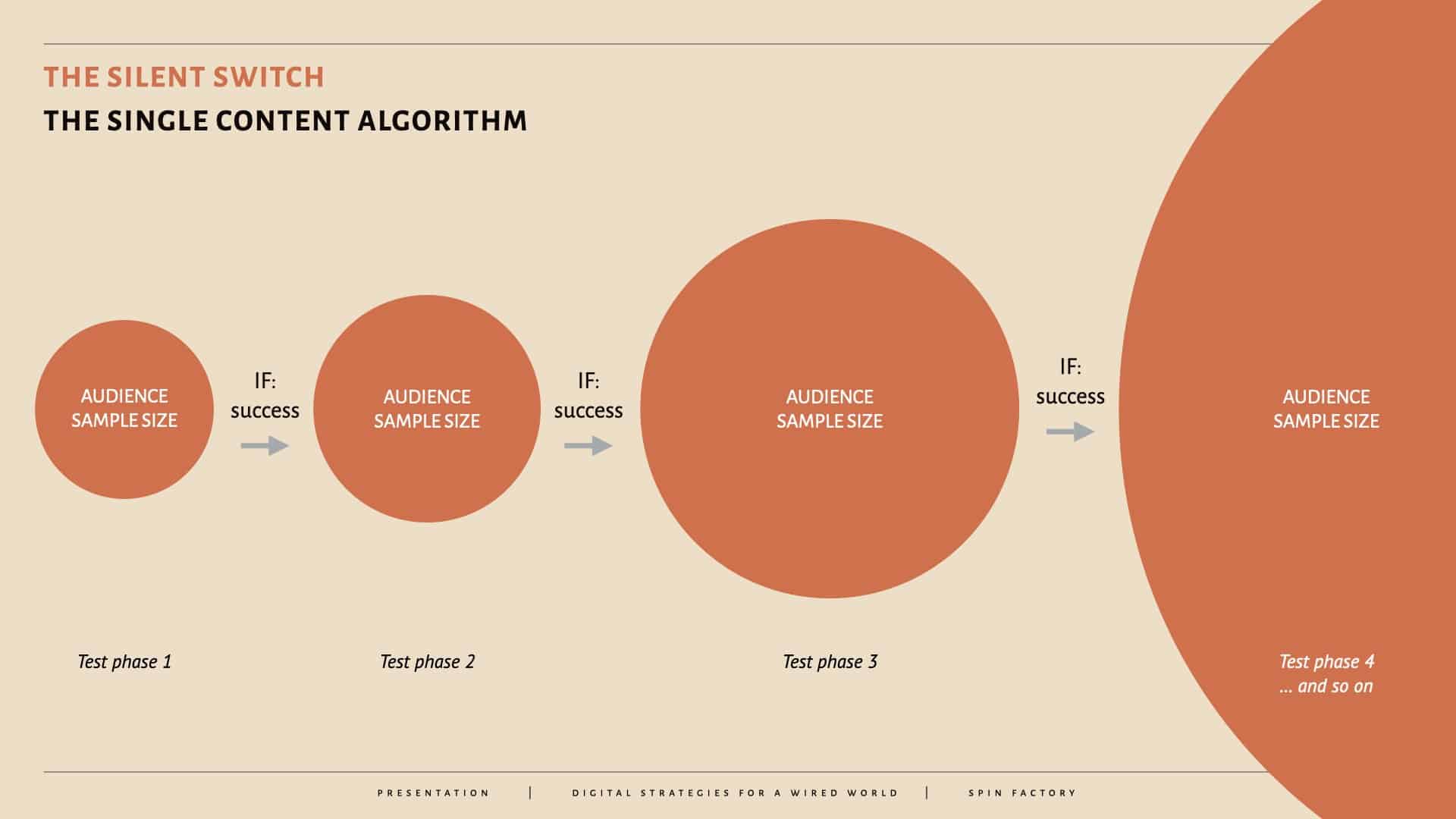
If McKinnon almost always gets a few hundred thousand views, his videos typically pass that many iterative audience tests before hitting the “algorithmic wall of bricks” (i.e. IF=failure).
It’s the silent switch.
Now, I appreciate McKinnon’s content. However, his struggle to earn more views is… his.
In the grander scheme of things, at the level where it affects us all as online media consumers, the single content algorithm has one profound — and rather serious! — implication:
Earning trust over time gets the algorithmic backseat, while sensational pieces of content get the royal treatment.
Learn more: Why Subscriber Counts Matter Less
The Silent Switch
All social media algorithms are built differently and are constantly being developed. At the same time, social media users’ behaviours are evolving.
Still, there was a way that social media algorithms used to behave—and there is a way that social media algorithms behave now.
This has been a fundamental but silent switch.
How Social Media Algorithms Used To Behave
For more than a decade, social media algorithms would deliver organic reach according to a distribution that looked something like this:

This distribution of organic reach enabled organisations to use social media despite not being “media companies.”
How Social Media Algorithms Behave Today
Today, after the silent shift, social media algorithms deliver organic reach more like this:
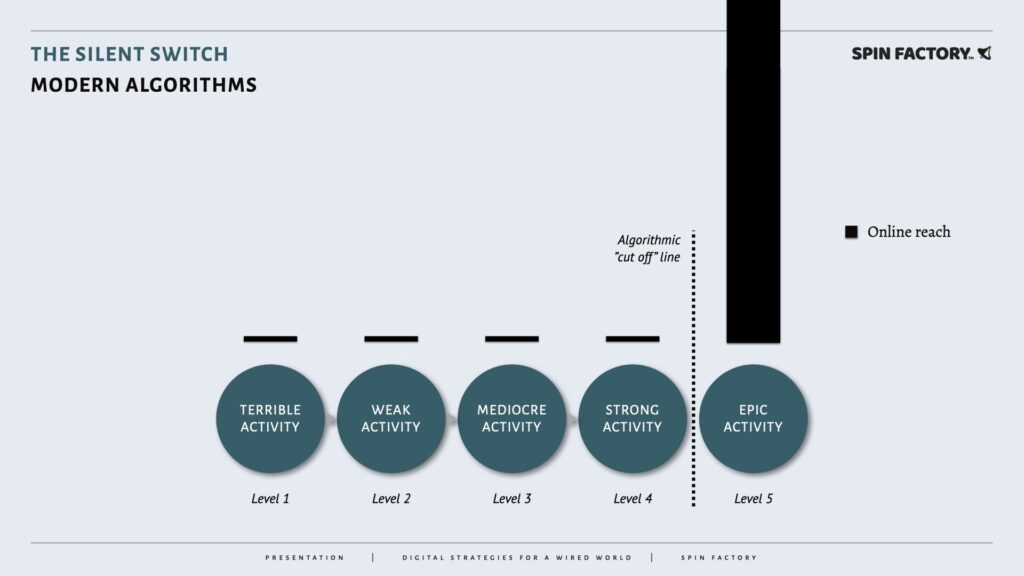
The increased competition and sophistication among content creators partially explain this new type of distribution. However, going viral is still just as possible for anyone.
How does this work?
The Single Content Algorithm
How can a social network predict what users will like?
Content from a trusted creator trusted by a large community of followers used to be the leading indicator of future performance. But today, social networks have found a better way to predict content success.
The single content algorithm = when social networks demote content creator authority to promote single content performance to maximise user engagement for ad revenue.
The single content algorithm presents newly published content to a limited audience sample size:

If the newly published content tests successfully, the social media algorithm pushes that content to a slightly larger statistical subset. And so on.
This iterative process means that single pieces of content worthy of going viral will go viral, a) even if it takes a longer time, and b) regardless of the content creator’s number of followers.
Learn more: The Silent Switch
Thanks for reading. Need a PR specialist?
Please contact Jerry for a consultation.
What should you study next?
Spin Academy | Online PR Courses

Spin’s PR School: Free Social Media PR Course
Discover this free Social Media PR Course and master the art of digital public relations on social networks and platforms. Explore now for valuable insights!
Social Media Psychology
Social Media Management
Social Media Issues
Learn more: All Free PR Courses
💡 Subscribe and get a free ebook on how to get better PR.



Social Media Mechanics