

The spiral of silence is an influential media theory.
The fear of guilt by association is so powerful that individuals would consider supporting a cause they strongly disagree with — from fear of social isolation.
However, self-induced silence can also be a breeding ground for populism and cancel culture.
Here we go:
Spiral of Silence
The spiral of silence occurs when individuals refrain from expressing their opinions because they perceive that their views are in the minority or not socially acceptable. This fear of isolation or rejection leads to a self-reinforcing cycle where more and more people choose silence, reinforcing the dominance of the prevailing viewpoint, even if it doesn’t reflect the true diversity of opinions.
Spiral of silence (example): “I disagree with the majority opinion about this new policy, but since everyone else seems to support it, I’ll keep quiet to avoid conflict.”
In a business context, the spiral of silence can prevent valuable dissenting perspectives from being heard, leading to groupthink and poor decision-making. When employees, stakeholders, or teams feel pressured to conform to the majority view, critical feedback or alternative ideas may be suppressed, which can hinder innovation, create blind spots, and result in suboptimal outcomes.
To break the spiral of silence, business leaders should create an open and inclusive environment where all voices are encouraged and valued, regardless of how they align with the majority opinion.
Encouraging constructive debate, ensuring psychological safety, and actively seeking diverse perspectives help prevent the stifling of critical thought. By promoting an atmosphere where dissent is seen as a strength rather than a weakness, organisations can make better-informed decisions and foster a culture of innovation and growth.
In the quiet of consensus, loud truths are often drowned by the fear of standing alone.
Learn more: The Spiral of Silence
The Spiral of Silence Theory
Elisabeth Noelle-Neumann’s (1916 – 2010) well-documented theory on the spiral of silence (1974) explains why the fear of isolation due to peer exclusion will pressure publics to silence their opinions.

The theory was developed in the late 1970s in West Germany, partly in response to Noelle-Neumann’s observations of how public opinion seemed to shift during the Nazi régime and post-war Germany.
The spiral of silence theory is based on the idea that people fear social isolation. This fear influences their willingness to express their opinions, especially if they believe these opinions are in the minority.
Rather than risking social isolation, many choose silence over expressing their opinions.
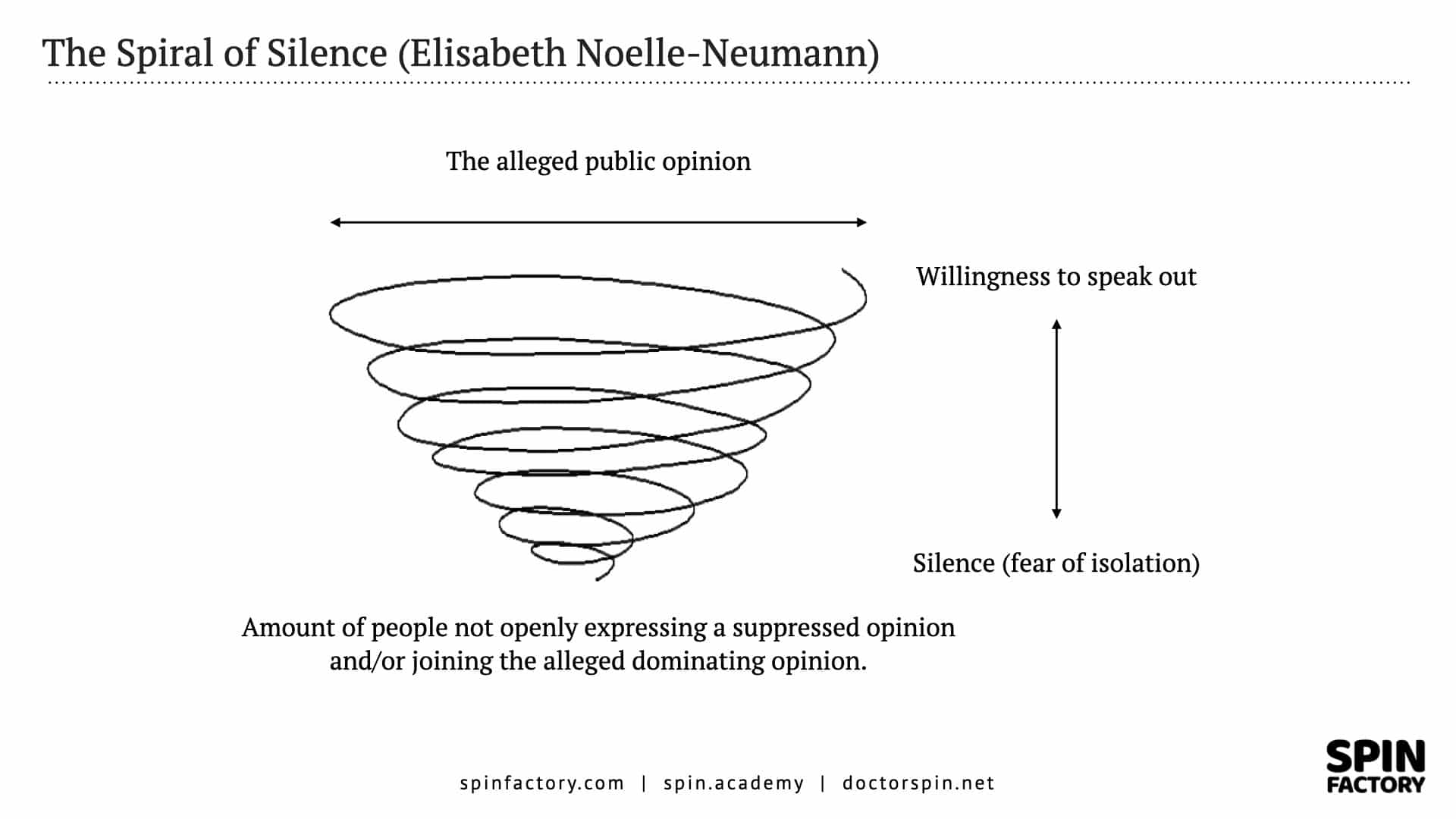
As the dominant coalition stands unopposed, they push the confines of what’s acceptable down a narrower and narrower funnel, the so-called opinion corridor). 1Opinion corridor. (2023, April 8). In Wikipedia. https://en.wikipedia.org/wiki/Opinion_corridor
Noelle-Neumann emphasised the media’s role in shaping public perception of what opinions are dominant or popular, thus influencing the spiral of silence.
Populism and Cancel Culture
The mechanisms behind Elisabeth Noelle Neumann’s spiral of silence theory could fuel destructive societal phenomena like populism and cancel culture:
In both cases, the spiral of silence contributes to a polarised environment. Views become dominant not necessarily because they are more popular but because opposing views are not expressed due to fear of social isolation or repercussions.
Learn more: The Spiral of Silence
Cancel Culture is Evil
What is cancel culture?
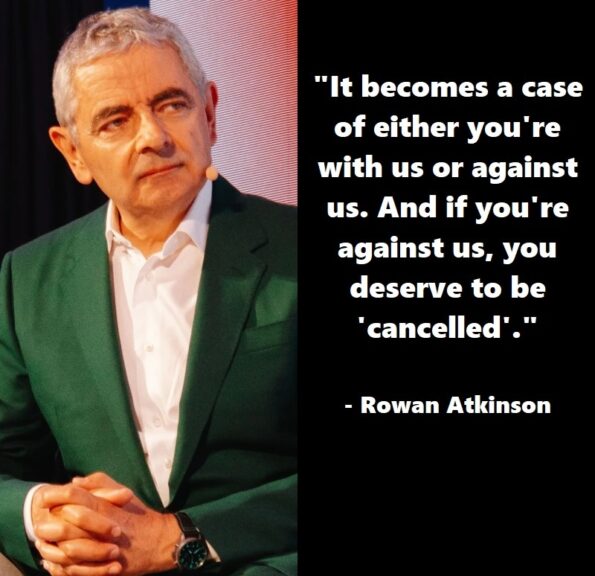
Cancel culture = the weaponisation of social outrage to silence, punish, and exile individuals or ideas rather than engaging with them in rational debate.
Cancel culture thrives on public shaming, digital mob justice, and eliminating nuance, reducing complex human beings to single statements or actions — often taken out of context or judged retroactively by evolving moral standards.
“Cancel culture or call-out culture is a phrase contemporary to the late 2010s and early 2020s used to refer to a form of ostracism in which someone is thrust out of social or professional circles — whether it be online, on social media, or in person. Those subject to this ostracism are said to have been ‘cancelled’.”
Source: Wikipedia 4Cancel culture. (2023, January 4). In Wikipedia. https://en.wikipedia.org/wiki/Cancel_culture
Conformity, Oppression, and Stagnation
Unlike traditional accountability, which allows for discussion, learning, and proportional consequences, cancel culture demands immediate and absolute destruction.
Historically, societies that have embraced ideological purges — whether in the form of book burnings, blacklists, or political witch hunts — have not led to progress but instead to oppression and intellectual stagnation. Cancel culture, while often disguised as activism, is fundamentally a modern form of authoritarian control, ensuring conformity not through reason but through intimidation.
In its most extreme form, cancel culture leads to collective amnesia, erasing people, books, films, and even historical figures from public life, as if uncomfortable realities can be scrubbed from existence.
What makes cancel culture particularly insidious is that it operates outside formal institutions, giving unaccountable digital mobs the power to act as judges, juries, and executioners.
The Terror of Being Next
“Cancel culture on social media is a form of public shaming that aims to diffuse public discourse and promote tolerance, but can also be viewed as a form of intolerance against opposing views.”
Source: Rupkatha Journal on Interdisciplinary Studies in Humanities 5Velasco, J. (2020). You are Cancelled: Virtual Collective Consciousness and the Emergence of Cancel Culture as Ideological Purging. Rupkatha Journal on Interdisciplinary Studies in Humanities, 12. … Continue reading
Cancel culture replaces conversation with coercion, creating a world where moral purity is performative and intellectual exploration is replaced by ideological conformity.
A society ruled by the fear of cancellation is not a free society — it is a social panopticon in which people are not guided by moral conviction but by the terror of being next.
It creates an atmosphere of fear (i.e. the spiral of silence), where people are afraid to express dissenting opinions, ask difficult questions, or challenge prevailing dogmas. This stifles creativity, intellectual diversity, and essential human interaction, as individuals constantly self-censor to avoid social annihilation.
How To Navigate Cancel Culture
The culture war with de-platforming, cancel culture, online lynch mobs, woke journalism, populism, fake news, and moral slacktivism are fast becoming our biggest challenges as PR professionals.
Here’s how to navigate cancel culture:
Learn more: Cancel Culture is Evil
The Conversion Theory
The social psychologist Serge Moscovici found that we become more engaged if we belong to a misrepresented minority.
The disproportional power of minorities is known as the conversion theory. 6Conversion theory of minority influence. (2021, February 12). In Wikipedia. https://en.wikipedia.org/wiki/Conversion_theory_of_minority_influence
“In groups, the minority can have a disproportionate effect, converting many ‘majority’ members to their own cause. This is because many majority group members are not strong believers in its cause. They may be simply going along because it seems easier or that there is no real alternative. They may also have become disillusioned with the group purpose, process, or leadership and are seeking a viable alternative.”
Source: Changingminds.org 7Conversion Theory. (2023). Changingminds.org. https://changingminds.org/explanations/theories/conversion_theory.htm
How does it work?
The social cost of holding a different view than the majority is high. This increased cost explains why minorities often hold their opinions more firmly. It takes determination to go against the norm. 8Moscovici, S. (1980). Toward a theory of conversion behaviour. In L. Berkowitz (Ed.), Advances in Experimental Social Psychology, 13, 209 – 239. New York: Academic Press
In contrast, many majority members don’t hold their opinions so firmly. They might belong to the majority for no other reason than that everyone else seems to be. 9Chryssochoou, X. and Volpato, C. (2004). Social Influence and the Power of Minorities: An Analysis of the Communist Manifesto, Social Justice Research, 17, 4, 357 – 388
According to conversion theory, while majorities often claim normative social influence, minorities strive for ethical high ground.
Conversion Theory Examples
Given the power of normative social influence, minorities typically form tight-knit groups that can gather around a core message.
Most big shifts usually start with a small group of dedicated people:
Minority Influence: A PR Approach
Organisations with CSR aspirations can cultivate a sense of purpose and accomplishment among participants by aligning with a movement that challenges a stupid majority.
Since we tend to favour underdogs, liaising with a carefully selected minority can be a game-changing PR strategy.
Minority spokespersons with solid convictions often possess valuable knowledge and authority, enhancing their persuasive abilities and influence.
Disproportionately, minorities can convert numerous majority members to their cause, as many in the majority may have merely followed the path of least resistance, made decisions without much consideration, or lacked viable alternatives.
Additionally, a significant segment of the majority might be disillusioned with their group’s purpose, process, or leadership, rendering them more receptive to alternative proposals.
Proceed With Caution, Please
As PR professionals, we must be cautious when implementing the conversion theory.
Minorities aren’t always right, and majorities aren’t always wrong. Minorities can hold futile views while still exercising a disproportionate amount of power.
Learn more: Conversion Theory: The Disproportionate Influence of Minorities
Thanks for reading. Need a PR specialist?
Please contact Jerry for a consultation.
What should you study next?
Spin Academy | Online PR Courses

Spin’s PR School: Free Media PR Course
Elevate your public relations skills with this free Media PR Course—a must-have resource for all aspiring public relations professionals. Boost your career now!
Media Theory
Media Logic
Journalism
Digital Media
Learn more: All Free PR Courses
💡 Subscribe and get a free ebook on how to get better PR.

Annotations
| 1 | Opinion corridor. (2023, April 8). In Wikipedia. https://en.wikipedia.org/wiki/Opinion_corridor |
|---|---|
| 2 | Silfwer, J. (2018, August 6). How To Fight Populism. Doctor Spin | The PR Blog. https://doctorspin.net/how-to-fight-populism/ |
| 3 | Silfwer, J. (2020, August 24). Cancel Culture is Evil. Doctor Spin | The PR Blog. https://doctorspin.net/cancel-culture/ |
| 4 | Cancel culture. (2023, January 4). In Wikipedia. https://en.wikipedia.org/wiki/Cancel_culture |
| 5 | Velasco, J. (2020). You are Cancelled: Virtual Collective Consciousness and the Emergence of Cancel Culture as Ideological Purging. Rupkatha Journal on Interdisciplinary Studies in Humanities, 12. https://doi.org/10.21659/rupkatha.v12n5.rioc1s21n2 |
| 6 | Conversion theory of minority influence. (2021, February 12). In Wikipedia. https://en.wikipedia.org/wiki/Conversion_theory_of_minority_influence |
| 7 | Conversion Theory. (2023). Changingminds.org. https://changingminds.org/explanations/theories/conversion_theory.htm |
| 8 | Moscovici, S. (1980). Toward a theory of conversion behaviour. In L. Berkowitz (Ed.), Advances in Experimental Social Psychology, 13, 209 – 239. New York: Academic Press |
| 9 | Chryssochoou, X. and Volpato, C. (2004). Social Influence and the Power of Minorities: An Analysis of the Communist Manifesto, Social Justice Research, 17, 4, 357 – 388 |