

Digital PR is the strategic use of online channels.
Digital PR is one of several typical public relations specialisations — and part of the Stakeholder Model.
Here we go:
What is Digital PR?
As digital PR specialists, we must champion a comprehensive understanding of digital PR and educate our clients, colleagues, and the public about our discipline’s true scope and value.
Digital PR = the strategic use of online communication to build brand communities, foster engagement, and manage reputation in the digital space. 1Silfwer, J. (2017, November 20). What is Digital PR? Doctor Spin | The PR Blog. https://doctorspin.net/what-is-digital-pr/
Targets: Inbound web traffic, brand communities, subscribers, fans, followers, influencers, social networks, etc.
Here’s an overview of digital PR capabilities:
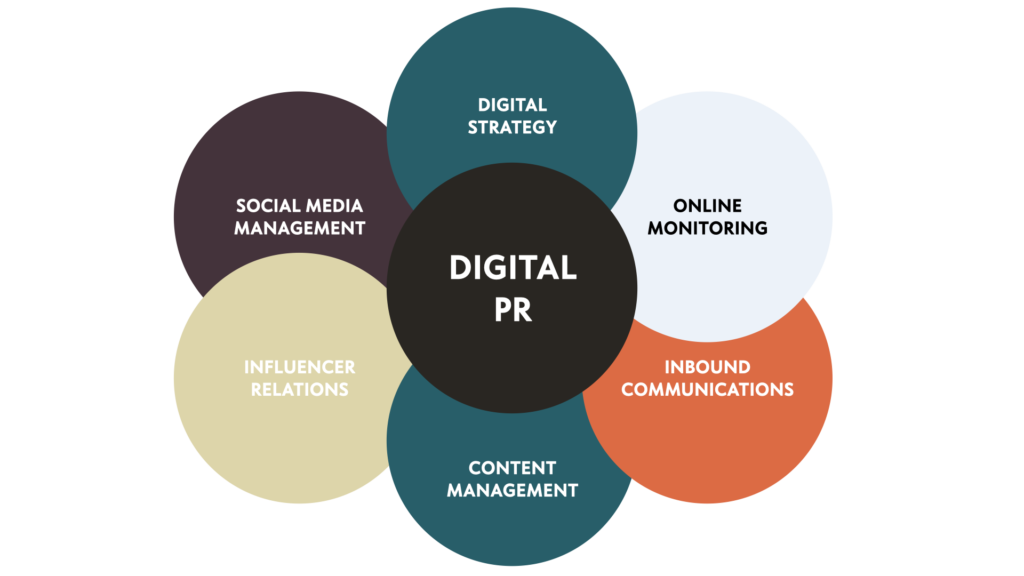
Digital Strategy
Digital strategy = the purposeful use of digital tools and platforms to align communication goals with measurable outcomes and evolving brand audience behaviours.
Examples of activities:
Online Monitoring
Online monitoring = systematically tracking digital conversations, mentions, and trends to assess brand sentiment, manage crises, and gather actionable insights.
Examples of activities:
Content Management
Content management = the structured approach to creating, organising, publishing, and optimising digital assets to engage brand audiences and achieve communication objectives.
Examples of activities:
Influencer Relations
Influencer relations = the strategic use of communication to establish and sustain productive brand partnerships with online influencers to amplify reach and foster trust.
Examples of activities:
Inbound Communications
Inbound communications = the targeted use of digital channels to attract, engage, and convert brand audiences by providing valuable, relevant information.
Examples of activities:
Social Media Management
Social media management = the deliberate use of social platforms to interact with audiences, build brand communities, and manage the online presence and reputation.
Examples of activities:
Learn more: What is Digital PR?
The Stakeholders in Public Relations
In public relations (PR), we often discuss stakeholders:
Stakeholders = representatives of various vested interests directly or indirectly connected to a brand. 2Silfwer, J. (2021, January 5). The Stakeholders in Public Relations. Doctor Spin | The PR Blog. https://doctorspin.net/stakeholders-in-public-relations/
The PR function is not just about managing media relations or marketing PR; it’s about comprehensively managing relationships with diverse stakeholder groups, each with unique information needs.
Different Information Needs
Why are stakeholders so important in PR?
Marketing is typically tasked with increasing an organisation’s sales of products and services. However, many other information needs must also be met.
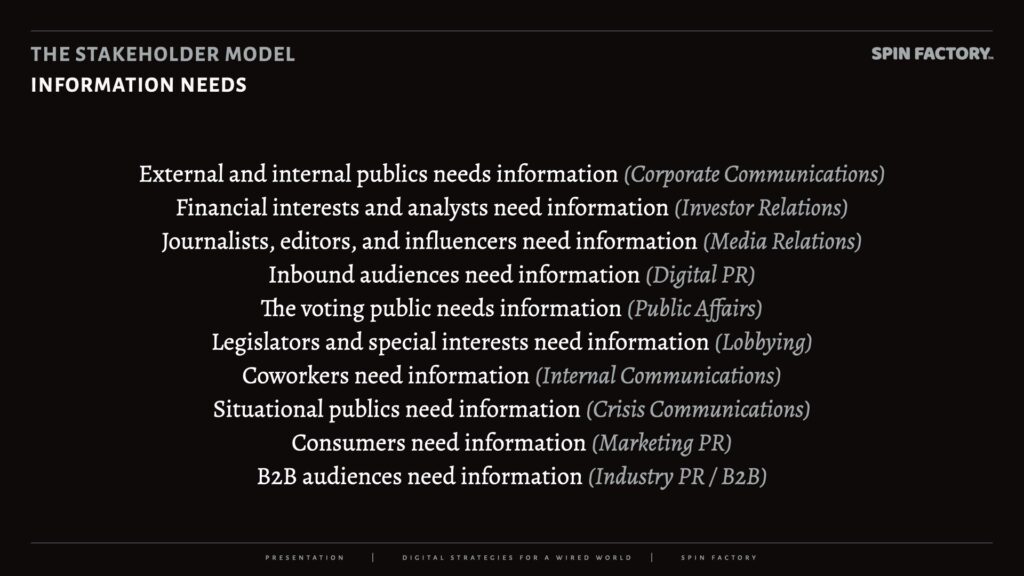
Establishing and sustaining relationships with various stakeholders is a significant challenge for PR professionals since their information needs are typically very different.
This requires understanding each stakeholder’s situational perspective, interests, and communication preferences.
The challenge for PR professionals is effectively identifying and addressing these varied needs. It involves crafting tailored communication strategies that resonate with each stakeholder group while maintaining a cohesive core message that aligns with the PR objectives.
“Public relations distinguishes itself from marketing by focusing on the stakeholder-organization relationship, which comprises mutual orientation around a common interest point and a multiplicity of stakes.”
Source: Public Relations Review 3Smith, B. (2012). Public relations identity and the stakeholder – organization relationship: A revised theoretical position for public relations scholarship. Public Relations Review, 38, 838 – 845. … Continue reading
The PR Stakeholder Model
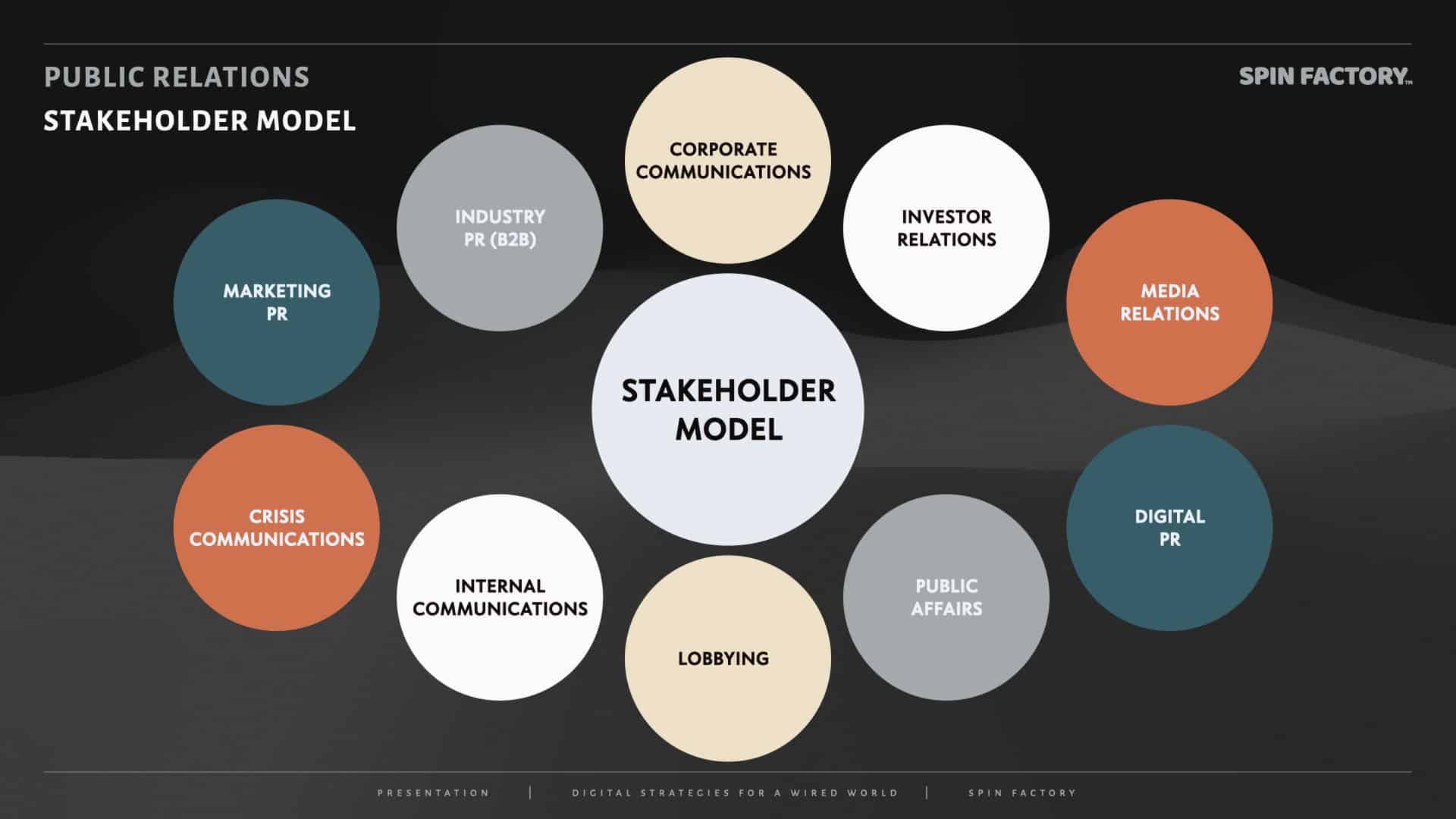
PR professionals have various specialisations (based on the stakeholder model), including corporate communications, investor relations (IR), media relations, digital PR, public affairs (PA), lobbying, internal communications (IC), crisis communications, marketing PR, and industry PR (B2B).
“In a corporation, a stakeholder is a member of ‘groups without whose support the organisation would cease to exist’, as defined in the first usage of the word in a 1963 internal memorandum at the Stanford Research Institute. The theory was later developed and championed by R. Edward Freeman in the 1980s. Since then it has gained wide acceptance in business practice and in theorising relating to strategic management, corporate governance, business purpose and corporate social responsibility (CSR).”
Source: Wikipedia 4Stakeholder (corporate). (2023, October 27). In Wikipedia. https://en.wikipedia.org/wiki/Stakeholder_(corporate)
PR Specialisations (Based on Stakeholders)
PR specialisations are typically named based on which stakeholder type they manage:
Corporate communications = an organisation’s strategic use of messaging to shape its reputation, articulate its vision, and engage with key audiences across internal and external channels.
Targets: External and internal publics, business journalists, regulatory institutions, partners, suppliers, vendors, etc.
Investor relations (IR) = an organisation’s deliberate communication efforts to build trust and maintain transparency with investors, analysts, and the financial community.
Targets: Shareholders, investors, market hubs, market analysts, financial institutions, trade journalists etc.
Media relations = a brand’s targeted use of communication to foster positive interactions with journalists, editors, and media outlets and to gain favourable coverage.
Targets: Journalists, editors, influencers, etc.
Digital PR = the strategic use of online communication to build brand communities, foster engagement, and manage reputation in the digital space. 5Silfwer, J. (2017, November 20). What is Digital PR? Doctor Spin | The PR Blog. https://doctorspin.net/what-is-digital-pr/
Targets: Inbound web traffic, brand communities, subscribers, fans, followers, influencers, social networks, etc.
Public affairs (PA) = a brand’s intentional use of communication to engage with governments, policymakers, and communities to influence public policy and social impact.
Targets: Voters, political journalists, political analysts, columnists, interest groups, etc.
Lobbying = the focused use of advocacy and communication to directly influence legislative and regulatory decisions in favour of specific interests or causes.
Targets: Politicians, legislators, government officials, committees, influencers, etc.
Internal communications (IC) = an organisation’s deliberate use of messaging to align, inform, and motivate employees while fostering a productive workplace culture.
Targets: Coworkers, potential recruits, etc.
Crisis communications = a brand’s rapid, strategic deployment of communication to mitigate reputational damage, address urgent challenges, and restore public trust during critical situations.
Targets: Crisis victims, worried publics, the general public, coworkers, journalists, influencers, customers, shareholders, etc.
Marketing PR = a brand’s tactical integration of communication and promotional efforts to enhance product awareness, drive sales, and support marketing objectives.
Targets: Potential customers, existing customers, trade journalists, members, affiliates, etc.
Industry PR (B2B) = a business’s purposeful use of communication to build credibility, foster trust, and establish thought leadership within its professional sector.
Targets: B2B clients, B2B prospects, trade journalists, trade organisations, niche influencers, etc.
Learn more: Stakeholders in Public Relations
Thanks for reading. Need a PR specialist?
Please contact Jerry for a consultation.
Annotations
| 1, 5 | Silfwer, J. (2017, November 20). What is Digital PR? Doctor Spin | The PR Blog. https://doctorspin.net/what-is-digital-pr/ |
|---|---|
| 2 | Silfwer, J. (2021, January 5). The Stakeholders in Public Relations. Doctor Spin | The PR Blog. https://doctorspin.net/stakeholders-in-public-relations/ |
| 3 | Smith, B. (2012). Public relations identity and the stakeholder – organization relationship: A revised theoretical position for public relations scholarship. Public Relations Review, 38, 838 – 845. https://doi.org/10.1016/J.PUBREV.2012.06.011 |
| 4 | Stakeholder (corporate). (2023, October 27). In Wikipedia. https://en.wikipedia.org/wiki/Stakeholder_(corporate) |