

There are five stages of the digital transformation hierarchy.
Digital transformation is a worthy undertaking for any business hoping to thrive in the 21st-century online cacophony.
It’s not just about staying alive in the digital space — it’s about thriving, leading, and transforming the industry around you. The digital transformation journey isn’t a straight line — it’s a series of stages, each building on the last.
Here we go:
The Digital Transformation Hierarchy
Drawing inspiration from Maslow’s hierarchy of needs, I’ve broken down the pursuit of digital maturity into five distinct stages.
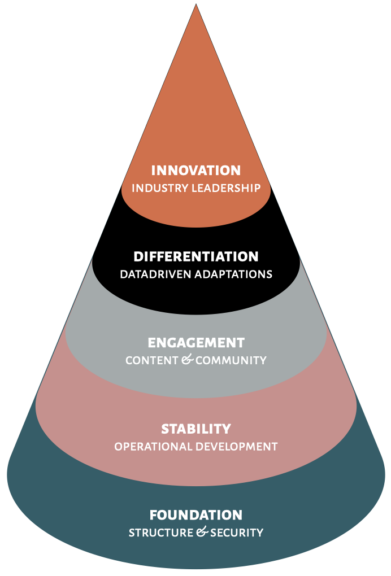
Just as humans start by meeting basic needs and progress towards self-fulfilment, businesses must meet foundational digital needs before reaching their full digital potential.
The 5 Stages of Digital Transformation
The transformation starts with the basic needs and works towards industry leadership and innovation.
Assess where you currently stand on this path and use it as a guide to move forward.
About Digital Transformation
“Digital transformation is an ongoing process using new digital technologies, with agility as the core mechanism for strategic renewal of an organization’s business model, collaborative approach, and culture.“
Source: Long Range Planning 1Warner, K., & Wäger, M. (2019). Building dynamic capabilities for digital transformation: An ongoing process of strategic renewal. Long Range Planning. https://doi.org/10.1016/J.LRP.2018.12.001
Learn more: The Digital Transformation Hierarchy
Stage 1: Foundation / Structure & Security
Every journey starts with the basics.
Businesses that have been around for a while all have a digital presence already, but it’s never too late to ensure it’s robust and secure enough to meet today’s challenges.
This stage is the digital equivalent of securing food, water, and shelter — ensuring your business can thrive in a competitive online environment.
Examples of needs:
Stage 2: Stability / Operational Development
Now that you’re surviving, it’s time to stabilise and optimise internal operations. Chances are, you already have some systems in place, but how can they be upgraded to ensure you’re running like a well-oiled machine? Digital stability is about improving efficiency and eliminating outdated or inefficient processes.
Examples of needs:
Stage 3: Engagement / Content & Community
Your operations are stable; it’s time to re-engage with your audience and build deeper relationships. You likely have a digital presence, but more must be done to ensure you connect meaningfully with your community.
Examples of needs:
Stage 4: Differentiation / Datadriven Adaptions
You’ve got the basics down, but now you must stand out. Differentiation is what will elevate your brand above competitors. You may have data insights and personalisation tools, but are they being used to their fullest potential?
Examples of needs:
Stage 5: Innovation / Industry Leadership
The final stage isn’t just about survival or optimisation but transformation. If your business has been around for a while, it’s time to leverage all you’ve built to become an industry leader. Innovate, disrupt, and lead the charge.
Examples of needs:
Digital Transformation
Digital transformation is a multifaceted process driven by advanced digital technologies requiring significant organisational change and adaptation. Despite the progress, organisations face numerous challenges, particularly at the initial stages of transformation.
“Digital transformation is an ongoing process using new digital technologies, with agility as the core mechanism for strategic renewal of an organization’s business model, collaborative approach, and culture.“
Source: Long Range Planning 2Warner, K., & Wäger, M. (2019). Building dynamic capabilities for digital transformation: An ongoing process of strategic renewal. Long Range Planning. https://doi.org/10.1016/J.LRP.2018.12.001
Technological Drivers and Enablers
Digital technologies such as mobile, AI, cloud, blockchain, and IoT (to name a few) can enable significant business improvements, enhancing customer experience, streamlining operations, and creating new business models. 3Warner, K., & Wäger, M. (2019). Building dynamic capabilities for digital transformation: An ongoing process of strategic renewal. Long Range Planning. … Continue reading 4Rogers, D., & Euchner, J. (2022). Digital Transformation. Research-Technology Management, 65, 11 — 17. https://doi.org/10.1080/08956308.2022.2095759 5Yaqub, M., & Alsabban, A. (2023). Industry‑4.0‑Enabled Digital Transformation: Prospects, Instruments, Challenges, and Implications for Business Strategies. Sustainability. … Continue reading
Industry 4.0 technologies are key drivers of digital transformation, enhancing competitiveness through environmental and social sustainability, corporate growth, and supply chain integration. 6Yaqub, M., & Alsabban, A. (2023). Industry‑4.0‑Enabled Digital Transformation: Prospects, Instruments, Challenges, and Implications for Business Strategies. Sustainability. … Continue reading
Organizational Adaptation and Change
Digital transformation moves organisations towards flexible designs that enable continuous adaptation, driven by digital business ecosystems. 7Hanelt, A., Bohnsack, R., Marz, D., & Antunes, C. (2020). A Systematic Review of the Literature on Digital Transformation: Insights and Implications for Strategy and Organizational … Continue reading
It is an ongoing process requiring agility for strategic renewal of business models, collaborative approaches, and organizational culture. 8Warner, K., & Wäger, M. (2019). Building dynamic capabilities for digital transformation: An ongoing process of strategic renewal. Long Range Planning. … Continue reading
Strategic Responses and Dynamic Capabilities
Organizations must develop dynamic capabilities to manage the disruptions caused by digital technologies and alter their value creation paths. 9Vial, G. (2019). Understanding digital transformation: A review and a research agenda. J. Strateg. Inf. Syst., 28, 118 – 144. https://doi.org/10.1016/J.JSIS.2019.01.003
Building dynamic capabilities involves recognizing and responding to triggers, enabling factors, and barriers within the organization. 10Warner, K., & Wäger, M. (2019). Building dynamic capabilities for digital transformation: An ongoing process of strategic renewal. Long Range Planning. … Continue reading
Challenges and Managerial Implications
Firms face significant challenges at the beginning of their digital transformation efforts, including cultural resistance and the need for new managerial guidance. 11Schneider, S., & Kokshagina, O. (2021). Digital transformation: What we have learned (thus far) and what is next. Creativity and Innovation Management. https://doi.org/10.1111/CAIM.12414
There is a need for a unified definition of digital transformation to provide conceptual rigor and guide both researchers and practitioners. 12Gong, C., & Ribière, V. (2021). Developing a unified definition of digital transformation. Technovation, 102, 102217. https://doi.org/10.1016/j.technovation.2020.102217 13Mergel, I., Edelmann, N., & Haug, N. (2019). Defining digital transformation: Results from expert interviews. Gov. Inf. Q., 36. https://doi.org/10.1016/J.GIQ.2019.06.002
Future Research Directions
There is a call for more practice-oriented research to address the remaining challenges and explore new themes in digital transformation.
Future research should focus on examining the role of dynamic capabilities and ethical issues in digital transformation. 14Schneider, S., & Kokshagina, O. (2021). Digital transformation: What we have learned (thus far) and what is next. Creativity and Innovation Management. https://doi.org/10.1111/CAIM.12414
Learn more: Digital Transformation: Overview

THANKS FOR READING.
Need PR help? Hire me here.

What should you study next?
Spin Academy | Online PR Courses

Spin’s PR School: Free Digital-First Course
Get started with this free Digital-First PR Course and learn essential public relations skills and concepts for future success in the PR industry.
The Electronic Age
Artificial Intelligence
Digital Transformation
Digital Public Relations
Learn more: All Free PR Courses
💡 Subscribe and get a free ebook on how to get better PR.

Annotations
| 1, 2 | Warner, K., & Wäger, M. (2019). Building dynamic capabilities for digital transformation: An ongoing process of strategic renewal. Long Range Planning. https://doi.org/10.1016/J.LRP.2018.12.001 |
|---|---|
| 3, 8, 10 | Warner, K., & Wäger, M. (2019). Building dynamic capabilities for digital transformation: An ongoing process of strategic renewal. Long Range Planning. https://doi.org/10.1016/J.LRP.2018.12.001 |
| 4 | Rogers, D., & Euchner, J. (2022). Digital Transformation. Research-Technology Management, 65, 11 — 17. https://doi.org/10.1080/08956308.2022.2095759 |
| 5, 6 | Yaqub, M., & Alsabban, A. (2023). Industry‑4.0‑Enabled Digital Transformation: Prospects, Instruments, Challenges, and Implications for Business Strategies. Sustainability. https://doi.org/10.3390/su15118553 |
| 7 | Hanelt, A., Bohnsack, R., Marz, D., & Antunes, C. (2020). A Systematic Review of the Literature on Digital Transformation: Insights and Implications for Strategy and Organizational Change. Journal of Management Studies. https://doi.org/10.1111/JOMS.12639 |
| 9 | Vial, G. (2019). Understanding digital transformation: A review and a research agenda. J. Strateg. Inf. Syst., 28, 118 – 144. https://doi.org/10.1016/J.JSIS.2019.01.003 |
| 11, 14 | Schneider, S., & Kokshagina, O. (2021). Digital transformation: What we have learned (thus far) and what is next. Creativity and Innovation Management. https://doi.org/10.1111/CAIM.12414 |
| 12 | Gong, C., & Ribière, V. (2021). Developing a unified definition of digital transformation. Technovation, 102, 102217. https://doi.org/10.1016/j.technovation.2020.102217 |
| 13 | Mergel, I., Edelmann, N., & Haug, N. (2019). Defining digital transformation: Results from expert interviews. Gov. Inf. Q., 36. https://doi.org/10.1016/J.GIQ.2019.06.002 |